Mine Vision Ecosystem is the parent holding company behind a family of AI platforms that guide mining operations — from the surface of the earth to the depths of the ocean, from satellite intelligence to the frontier beyond Earth.
Mining operates across four distinct operational domains, each with unique challenges and opportunities. Rather than isolated solutions, Mine Vision Ecosystem was built to master them all simultaneously.
Each frontier has fundamentally different constraints — data sources, equipment, regulations, and timelines. A single platform cannot excel at all four. But a holding company uniting them creates an ecosystem that covers the complete mining value chain and anticipates the industry's future.
Market opportunity: $53-77B (AI-addressable mining tech, 2024-2035). Timing: now for land and subsurface; 3-7 years for marine; 5-20 years for space.
Read the full vision →Open-pit operations, fleet logistics, equipment intelligence. 65% of current market.
Underground hard-rock mining with entirely different AI requirements. 30% of market.
Deep-sea minerals and autonomous marine robotics. 5-15% projected by 2035.
Lunar and asteroid resources. Long-term horizon; first-mover advantage critical.
Mining is one of humanity's oldest industries, yet its intelligent tools are still in their infancy. Mine Vision Ecosystem was built to close that gap: a family of specialized platforms, each reimagining one part of the mining value chain with artificial intelligence.
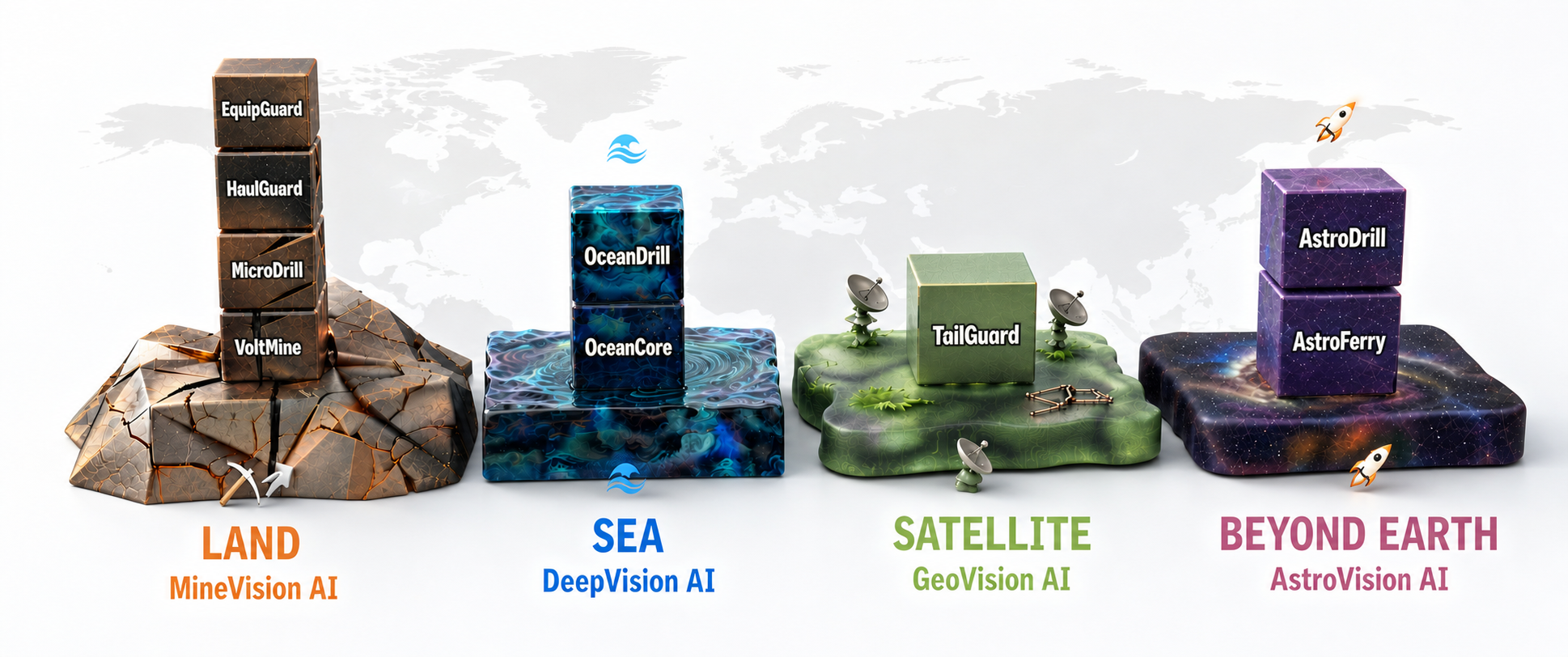
Rather than isolated solutions, the ecosystem is organized around four operational frontiers — each with its own independent mother platform, supported by subsidiaries that solve specific operational problems.
Each branch rises from a shared foundation — the parent company — and extends toward its own specialized operations.
* Future moonshot concepts
 01 / LAND
The most mature branch — surface mining operations, fleet logistics, equipment intelligence, and electrification across active operations.
 02 / SEA
Autonomous deep-sea mining operations, supported by AI governance and marine-specific robotics platforms.
 03 / SATELLITE
Exploration intelligence built on satellite and geophysical data, extended into environmental monitoring and regulatory compliance.
 04 / BEYOND EARTH
The ecosystem's long-term frontier — planetary mining robotics and operations infrastructure for lunar and asteroid resources.
44 field photographs and videos behind Mine Vision Ecosystem — from the KSP-32 robot to operating mines and international industry stages.
Learn how Mine Vision Ecosystem is building the AI infrastructure for mining's future across all operational frontiers — from proven land operations to emerging marine and space opportunities.
AstroVision AI's future product line will split into AstroDrill AI (planetary drilling robot) and AstroFerry AI (return module) — continuing the ecosystem's pattern of specialized subsidiaries.
Currently a subsidiary of the Sea branch, Ocean Core may eventually spin into its own independent division if marine operations scale significantly — an "Emerging Technologies" branch.
Environmental and compliance monitoring will expand beyond satellite imagery to multi-source intelligence — supporting both regulatory requirements and operational optimization across all branches.

Ramin Entezari is a mining engineer and industry veteran with 23 years of frontline experience across underground and open-pit operations. In 2014, he led the design and development of the KSP-32 remote-controlled roadheader robot at Middle East Technical University, earning the Best Design Award at the Tehran International Tunnel Exhibition. He is a PhD candidate at Istanbul University–Cerrahpaşa, researching an integrated economic-environmental life cycle assessment and optimal production planning model for rare earth element mining, and holds an Executive MBA and an MSc from METU. Today he leads Mine Vision Ecosystem's portfolio of AI-driven mining ventures spanning land, sea, satellite, and extraterrestrial operations.